
Role of Helium in the Evolving Healthcare Industry
When talking about Helium, one can think about its fun applications like in party balloons and creating squeaky voices. But, Helium is more than just a fun-to-play-around element. It plays an extremely important, indispensable and life-saving role in the medical industry.
Helium gas in healthcare has become an integral part of the medical infrastructure as it helps in multiple applications like diagnostic imaging and in intensive care units. The demand for high-purity Helium gases has gone up due to the increase in global demand in crucial fields like medicine.
Let’s take a look at how Helium is used in hospitals and why it plays an important role in the evolving healthcare industry:
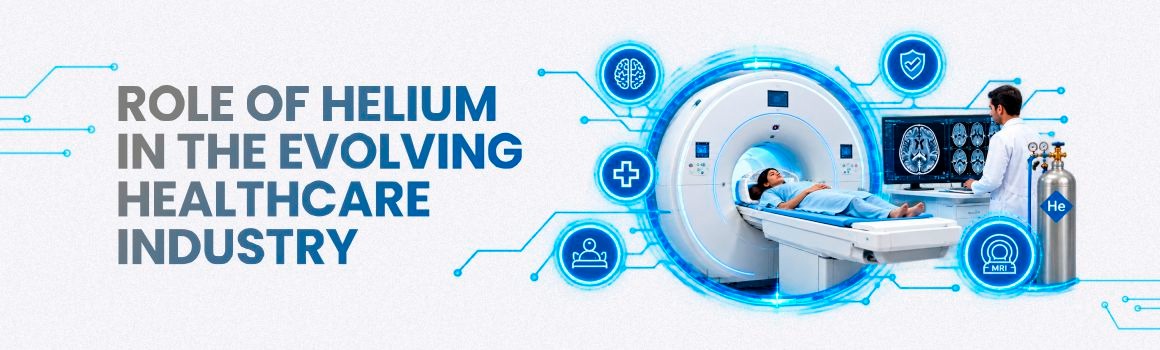
MRI machines are dependent on incredibly powerful superconducting magnets. These magnets are used to generate detailed images of organs, tissues and the brain through a non-invasive procedure. For these magnets to be able to achieve this superconductivity, they have to be kept at a stable cryogenic temperature of -269°C (near absolute zero).
Helium is one of the only substances on Earth that can reach temperatures this low and maintain them. Without the use of Helium for supercooling, the magnets would fail and the MRI infrastructure would collapse, stalling critical diagnostics.
Major applications of MRI include:
Because Helium’s exceptionally low density in comparison to normal atmospheric air, it can flow much smoother through restricted pathways. In the case of a patient experiencing respiratory distress, Heliox is used to get past the resistance, making it easier for the patient to breathe. Hospitals rely on Heliox therapy to stabilise patients suffering from the following:
Lung Functioning: Static lung volumes are measured with the Benedict Roth Spirometer; however, in this process, the functional residual capacity (FRC) and the Residual Volume (RV) cannot be measured reliably.
In this case, Helium dilution is used to measure the FRC. A spirometer apparatus is connected to a patient, where a known volume of Oxygen and Helium is used. The patient breathes normally until the Helium concentration is equilibrated. After equilibration the new FRC can be calculated after the new measurement of Helium. The process takes less than 10 minutes even in case of a severe lung disease.
Because Helium is chemically inert and diffuses predictably through human lungs, experts use Helium gas dilution techniques to measure the following:
Plasma coagulation is currently used in multiple applications like abdominal and laparoscopic surgery, ENT surgery and interventional bronchoscopy.
Helium: Neon lasers are used for blood cell counting and analysis, Medical positioning, and surgical sighting.
Helium: Cadmium Lasers are used for non-destructive testing and spectroscopy.
The healthcare industry is shifting to sustainable management where highly reliable supply chains are of utmost importance. It is important for the medical industry to incorporate zero-boil-off ecosystems that regulate fluid consumption.
Partnering with premium gas manufacturers like INOX Air Products makes it easy to achieve the above goals. With our state-of-the-art infrastructure, we are able to provide an uninterrupted supply of high-purity Helium gas. We combine our experience in medical partnerships and deliver the same level of sophistication for critical care units, diagnostic centres, and surgical suites to remain operational in India even during global market disruptions.
INOX Air Products continues to power these healthcare advancements, delivering the reliable gas solutions that medical professionals depend on every single day to save lives.
Helium gas in healthcare has become an integral part of the medical infrastructure as it helps in multiple applications like diagnostic imaging and in intensive care units. The demand for high-purity Helium gases has gone up due to the increase in global demand in crucial fields like medicine.
Let’s take a look at how Helium is used in hospitals and why it plays an important role in the evolving healthcare industry:
Cooling the Core of MRI Systems
Liquid helium has traditionally been used to maintain the superconducting magnets in MRI systems at approximately 4 K. Newer magnet designs significantly reduce helium consumption, but dependable helium management remains important across much of the installed MRI base.MRI machines are dependent on incredibly powerful superconducting magnets. These magnets are used to generate detailed images of organs, tissues and the brain through a non-invasive procedure. For these magnets to be able to achieve this superconductivity, they have to be kept at a stable cryogenic temperature of -269°C (near absolute zero).
Helium is one of the only substances on Earth that can reach temperatures this low and maintain them. Without the use of Helium for supercooling, the magnets would fail and the MRI infrastructure would collapse, stalling critical diagnostics.
Major applications of MRI include:
- Neurology (brain scans)
- Oncology (cancer detection)
- Cardiovascular assessments
- Orthopedic imaging
Heliox Therapy and Respiratory Care
Heliox may be used as an adjunct in selected cases of severe airway obstruction because its lower density can reduce turbulent airflow and the work of breathing. It does not treat the underlying cause and must be administered under appropriate clinical supervision.Because Helium’s exceptionally low density in comparison to normal atmospheric air, it can flow much smoother through restricted pathways. In the case of a patient experiencing respiratory distress, Heliox is used to get past the resistance, making it easier for the patient to breathe. Hospitals rely on Heliox therapy to stabilise patients suffering from the following:
- Acute asthma attacks
- Chronic Obstructive Pulmonary Disease (COPD)
- Upper airway obstructions
Pulmonary Diagnostics and Lung Functioning
When diagnosing respiratory issues, precision is of the utmost importance. This is one of the most important Helium gas uses in a clinical setting. Helium plays an important role in pulmonary function tests.Lung Functioning: Static lung volumes are measured with the Benedict Roth Spirometer; however, in this process, the functional residual capacity (FRC) and the Residual Volume (RV) cannot be measured reliably.
In this case, Helium dilution is used to measure the FRC. A spirometer apparatus is connected to a patient, where a known volume of Oxygen and Helium is used. The patient breathes normally until the Helium concentration is equilibrated. After equilibration the new FRC can be calculated after the new measurement of Helium. The process takes less than 10 minutes even in case of a severe lung disease.
Because Helium is chemically inert and diffuses predictably through human lungs, experts use Helium gas dilution techniques to measure the following:
- Residual lung volume
- Total lung capacity
- Early-stage respiratory disorders
Insufflation in Laparoscopy
In laparoscopic surgery the patient’s abdominal cavity is inflated; the process is called insufflation. The process is carried out to make space for the surgeons to work around the area. Carbon dioxide remains the standard gas for laparoscopic insufflation. Helium has been investigated as an alternative in selected circumstances because it is not absorbed and metabolised in the same way as CO₂, but its use is limited and requires careful management because of risks including gas embolism.Helium And Argon Plasma Technology in Surgery
Tissues are thermally coagulated using the plasma coagulator. The plasma coagulator is a non-contact electrocoagulation apparatus that uses ionised Helium or Argon gas to target affected tissues. Helium- and argon-based plasma technologies can deliver controlled energy to tissue for cutting, coagulation or ablation. Their clinical use depends on the specific device, procedure and regulatory approval. The jet stream also clears bleeding from the affected area, enhancing the visuals of the affected site during surgery.Plasma coagulation is currently used in multiple applications like abdominal and laparoscopic surgery, ENT surgery and interventional bronchoscopy.
Helium-Neon Laser
LASERs use inert gases like Helium, Argon, Krypton, and Xenon to generate photons of high-frequency light. The advantages of using Helium for lasers in the medical industry are as follows:Helium: Neon lasers are used for blood cell counting and analysis, Medical positioning, and surgical sighting.
Helium: Cadmium Lasers are used for non-destructive testing and spectroscopy.
Supply Challenges and Sustainability
Despite being one of the most abundant elements in the universe, Helium is a finite and non-renewable resource on Earth. Almost exclusively is it captured as a byproduct of natural gas extraction. Once it escapes, it leaves the atmosphere and goes straight into space. Having an undisrupted supply of helium is necessary for major applications like this. A disruption in gas supply can cause major operational risks for sensitive industries like medicine and hospitals.The healthcare industry is shifting to sustainable management where highly reliable supply chains are of utmost importance. It is important for the medical industry to incorporate zero-boil-off ecosystems that regulate fluid consumption.
Partnering with premium gas manufacturers like INOX Air Products makes it easy to achieve the above goals. With our state-of-the-art infrastructure, we are able to provide an uninterrupted supply of high-purity Helium gas. We combine our experience in medical partnerships and deliver the same level of sophistication for critical care units, diagnostic centres, and surgical suites to remain operational in India even during global market disruptions.
Conclusion
Helium is one of the most vital elements for the global medical infrastructure. From cooling magnets in MRI machines to reducing the airway resistance during an acute respiratory crisis, its role in modern medicine is of absolute importance.INOX Air Products continues to power these healthcare advancements, delivering the reliable gas solutions that medical professionals depend on every single day to save lives.
Get in Touch!
Maximize Productivity With Our High-Purity Gas Solutions