
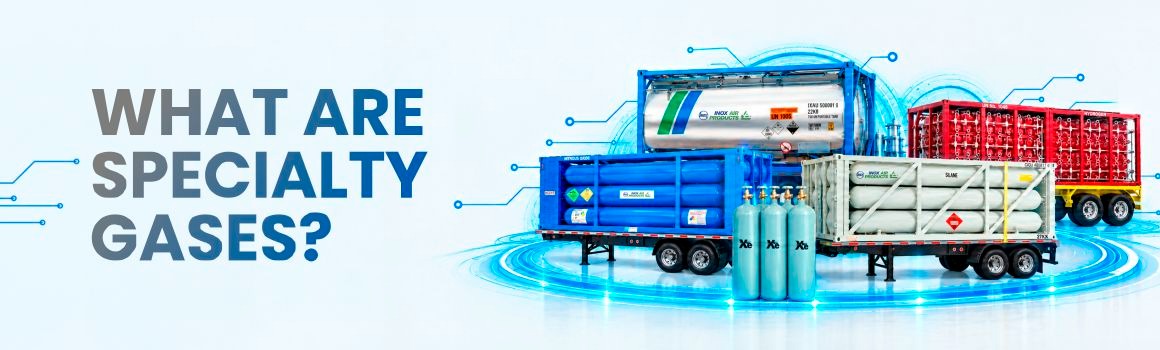
What are specialty gases?
In high-tech manufacturing, where heavy machinery and complex software take precedence. A silent, invisible component dictates whether a multi-billion-dollar production line succeeds or fails: specialty gases. In crucial industries like semiconductors, aerospace, or pharmaceuticals, “perfection” is everything. And specialty gases are made with this one specific requirement in mind.
Specialty gases are very different in comparison to the standard industrial oxygen or nitrogen gases. Specialty gases include high-purity gases and precisely formulated gas mixtures manufactured to meet tightly controlled specifications for composition, purity, stability and traceability.
In standard applications, a 1% impurity can be deemed passable. In high-tech fabrication, it is a catastrophe. Depending on the application, speciality gases may be supplied at purity levels of 5N, 6N or higher. Critical impurities such as moisture, oxygen and hydrocarbons may be individually controlled to extremely low ppm or ppb levels.
To put that into perspective: at these levels, we are managing impurities at the parts-per-billion (ppb) scale. Why? Because a single microscopic water molecule or a trace of oxygen can ruin a silicon wafer, degrade a laser’s precision, or contaminate life-saving medical batches. These gases are integral to the world’s most advanced technological sectors.
The Backbone of Global Innovation: Industry Applications
Specialty gases aren’t just commodities; they are the fundamental building blocks for the future. You’ll find them at the heart of every major technological breakthrough today:
- Semiconductor & Electronics: This is where the magic happens. Without UHP gases, we cannot manufacture the microchips that power everything from your smartphone to the AI servers running the global economy.
- Solar & Photovoltaics (PV): As the world moves toward a green energy future, the efficiency of solar cells depends entirely on the purity of the gases used during their manufacturing. High-efficiency PV cells require incredibly precise chemical vapour deposition.
- Healthcare & Life Sciences: From the gas mixtures used in precise lung-function diagnostics to the specialty gases that power surgical lasers and cryopreservation, these substances are literally saving lives every day.
- Aerospace & Defence: Whether it’s high-performance metal fabrication for jet engines or the precise propulsion systems required for satellite deployment, speciality gases support precision testing, calibration, controlled-atmosphere processing, leak detection and the manufacture of high-performance components.
- Environmental Monitoring: We can’t fix what we can’t measure. Specialty gases are the “gold standard” used to calibrate the ultra-sensitive equipment that monitors our air quality and industrial emissions.
From Atoms to Circuits: Core Applications
How are these gases actually used on the factory floor? They perform four critical functions that allow us to manipulate matter at an atomic scale:
- Thin-Film Deposition: The process of building layers of material atom-by-atom. By introducing specific gases into a vacuum chamber, manufacturers can make perfectly uniform layers of silicon or metal on a wafer.
- Plasma Etching: Think of this as high-tech carving. Gases are turned into high-energy plasma to shape specific parts of a surface, leaving behind intricate circuit patterns with nanometre precision.
- Ion Implantation: A process to program the electrical behaviour of a chip. By injecting gas ions into the silicon lattice, we create the positive and negative junctions that allow transistors to switch on and off.
- Chamber Cleaning: Manufacturing equipment gets dirty at a molecular level. Specialised cleaning gases are used to “scrub” the inside of reactors without damaging the sensitive hardware, ensuring maximum uptime and yield.
Our Specialty Gas Portfolio
To choose the right gas, you have to understand its chemical role. We categorise our portfolio into three distinct functional groups:
What are the Types of Gases?
1. CVD (Chemical Vapour Deposition) Gases
- Silane: The primary building block for silicon layers. It acts as the “ink” used to print the layers of a semiconductor.
- Diborane: A vital p-type dopant. It is highly reactive and must be handled with extreme care, as it dictates the electrical conductivity of the final product.
- Germane: Essential for high-speed transistors and infrared optics. It creates silicon-germanium alloys that allow electrons to move faster than ever before.
- Silicon Tetrafluoride: Primarily used in the manufacturing of optical fibres and specialised semiconductor layers. It serves as a stable source for silicon in various plasma-enhanced deposition processes.
- Ammonia: Ultra-pure ammonia is reacted with silane to create silicon nitride. This serves as a protective, insulating shield that keeps a chip safe from environmental damage.
- Phosphine: This serves as an n-type dopant, introducing phosphorus into silicon crystals. It is essential for creating the electrical junctions that allow transistors to switch signals.
- Dichlorosilane: Used for the epitaxial growth of silicon and the deposition of high-quality silicon nitride. It is preferred in high-temperature applications for its superior film uniformity.
- Disilane: A more reactive alternative to silane that allows for silicon deposition at much lower temperatures. This is critical for protecting sensitive layers in advanced chip architectures.
- Tungsten Hexafluoride: The industry standard for depositing tungsten metal interconnects. This gas creates the conductive wiring that links billions of transistors together on a single chip.
- Propylene: Used as a carbon source for depositing carbon-doped films. These films help reduce the capacitance between wires, making the chip operate more efficiently.
2. Cleaning & Etching Gases
- Nitrogen Trifluoride: NF₃ is widely used in remote-plasma chamber cleaning because it can provide high cleaning efficiency and gas utilisation. As NF₃ is a potent greenhouse gas, appropriate process controls and exhaust-abatement systems are essential to minimise emissions.
- Hexafluoroethane: Primarily used as a dry etchant for silicon dioxide and silicon nitride layers. It provides excellent precision when carving the vertical features of a microchip.
- Hexafluoro-1,3-butadiene: An advanced etching gas used for creating high-aspect-ratio holes in memory chips. It offers superior selectivity, meaning it only etches exactly where it is intended.
- Tetrafluoromethane: One of the most common gases used for plasma etching of various thin films. It is also used in deep-freeze applications due to its stability at extreme temperatures.
- Carbonyl Sulphide: Utilised in specialised etching processes to achieve extremely high precision between different material layers. It is increasingly vital as chip features shrink to the nanometre scale.
- Difluoromethane: Often used in combination with other fluorocarbons to etch silicon nitride. It helps control the shape and profile of the etched features with high accuracy.
- Sulphur Hexafluoride: A highly stable gas used for high-speed plasma etching of silicon. Its unique properties also make it an excellent electrical insulator for high-voltage equipment.
- Boron Trichloride: A reactive gas used primarily for etching aluminium and other metal layers. It is also used as a catalyst in various chemical manufacturing processes.
- Carbon Monoxide: Used in specialised etching recipes to improve the selectivity of the process. It helps protect certain layers of the chip while others are being carved away.
- Octafluoropropane: Frequently used for cleaning CVD chambers and as an etchant for specific dielectric materials. It provides a clean, residue-free finish after the etching process.
- Octafluorocyclopentene: A high-performance etching gas designed for very narrow circuit patterns. It offers an excellent balance between etching speed and precision.
- Trifluoromethane: Commonly used for etching silicon dioxide and as a refrigerant in specialised industrial systems. It is prized for its ability to create very straight, vertical etched walls.
- Pentafluoroethane: Used in plasma etching and as a fire suppression agent in high-tech facilities. It is valued for its stability and effectiveness in removing unwanted material.
- Methyl Fluoride: A specialised etching gas used for sensitive layers where high precision is required. It helps prevent damage to the underlying silicon while carving the top layers.
- Chlorine: A highly reactive gas used for etching metal lines and silicon gates. It is a fundamental tool for defining the conductive paths in electronic devices.
- Hydrogen Bromide: The preferred gas for gate etching because it creates perfectly vertical profiles. This precision is required to ensure modern high-performance processors work at top speed.
Why Partner with INOX Air Products?
In industries where a 1 ppb (part-per-billion) error can cost damage in millions, your gas supplier shouldn’t just be a vendor but a strategic partner. INOX Air Products is India’s leader because we understand that you aren’t just buying a product; you are buying a guarantee of support and growth.
Total Gas Management (TGM) involves overseeing the entire lifecycle of specialty and electronic gases, from production and transportation to distribution and consumption. It focuses on optimising efficiency, safety, and sustainability through processes like monitoring production rates, managing pipelines, ensuring regulatory compliance, and using advanced technologies for real-time monitoring. TGM also includes risk management, demand forecasting, and reducing environmental impact, all aimed at ensuring safe, reliable, and efficient operations of gases for semiconductor manufacturing across the supply chain. Additionally, it ensures precise handling of every gas used in semiconductor applications to maintain product quality and operational safety
Through our strategic partnership with Air Products, we bring the collective intelligence of over 100 global semiconductor and solar installations to the Indian market. You get global technology with a local, responsive supply chain.
We design, build and operate on-site generation plants for bulk gases, while supporting speciality and electronic-gas requirements through carefully managed sourcing, purification, packaging, storage and distribution solutions.
Semiconductor manufacturers need a reliable and responsive partner with a wide reach and the technical capability to safely supply semiconductor manufacturing gases, ensure the highest quality, manage costs, reduce environmental impact, and drive innovation for the future. At INOX Air Products, we are the leading manufacturer of Industrial gases committed to maintaining a sustainable and scalable value chain for the burgeoning semiconductor industry in India. We have been a supplier of choice for high-purity gases for manufacturers in India and, through our JV partner Air Products, in China, the USA, Taiwan, South Korea, Ireland, Israel, Malaysia, and the EU, with over 100 installations in this segment.
For more information, email us at info@inoxap.com or contact your INOX Air Products sales coordinator.