
Methane Gas (CH4)
Methane (CH4) is a colorless, odorless, and highly flammable chemical compound that consists of one carbon atom bonded with four hydrogen atoms. As the simplest alkane and the main constituent of natural gas, it plays a vital role across energy systems, chemical manufacturing, and high-precision production processes. Handling it properly requires a deep understanding of its physical characteristics, behavioral risks, and storage conditions to ensure safe operation in demanding settings
Properties and Industrial Significance
Chemical and Physical Characteristics
Methane remains in a gaseous state under normal ambient temperatures and standard atmospheric pressures. It features a lighter vapor density compared to ambient air, possesses a high heat value, and burns easily within a narrow lower explosive limit.
Environmental Footprint
Methane functions as a potent greenhouse gas that traps roughly 28 to 30 times more thermal energy in the atmosphere than carbon dioxide over a century-long span. Because of this property, preventing leaks during storage, transfer, and distribution is both an operational necessity and a regulatory obligation for industrial facilities.
Purity Demands in Manufacturing
In ultra-high-purity environments like semiconductor fabrication and precision research, even microscopic impurities at the parts per billion level can destroy product yields or skew sensitive analytical data.
Major Applications Across Industries
- ESG & Sustainability: When the gas is converted into liquid, it becomes easy to contain a higher amount in a smaller space compared to the gaseous state. This higher liquid density reduces the carbon footprint, as a higher amount can be transported in fewer shipments.
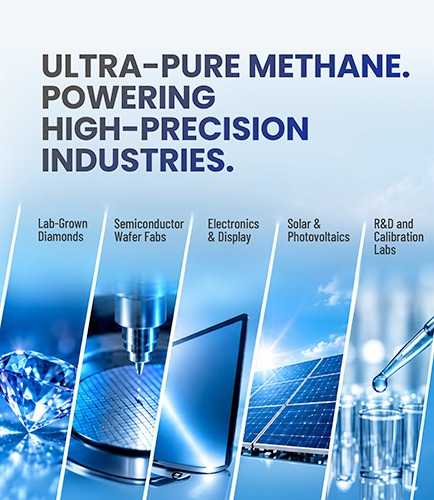
- Semiconductor Wafer Fabs: Critical processes use Methane with high purity. In microchip manufacturing, methane is used in critical plasma etching and chemical vapor deposition processes. Even tiny impurities (parts-per-billion level) or slight variations in gas pressure/flow can ruin an entire batch of silicon wafers, causing massive financial losses.
- Electronics & Display: Display and electronic manufacturing requires high-purity Methane gas. Methane acts as a carbon source in thin-film coating operations and semiconductor layer preparation across display panels. Because these factories run high-volume, continuous production lines, running out of gas mid-cycle or swapping high-pressure cylinders creates unwanted downtime. A cryogenic micro-cylinder provides longer autonomy and seamless flow for uninterrupted high-volume runs.
- Advanced Materials (CVD, ALD, MOCVD): Methane serves as a precise carbon precursor. Because ALD and CVD require precise stoichiometric balances, any pressure drop or purity fluctuation disrupts layer uniformity at the nanoscale. These processes require continuous ultra-high-purity feed for precision material deposition.
- Solar & Photovoltaics (PV): During the production of thin-film solar cells, carbon-doped layers or passivation films are applied to improve solar light absorption and cell efficiency. Methane is required to deposit Carbon atoms in the production of thin-film solar cells.
- Calibration and R&D labs: High-precision research and testing labs such as analytical testing centers and R&D departments require Methane as a reference standard. In these environments, any impurity in the methane gas distorts analytical baseline measurements and experimental outcomes, making UHP grade essential.
Supply Options and Infrastructure
Our Portable Cryo Pure Methane Cylinders store Methane as an ultra-high-purity cryogenic liquid with vacuum insulation. They feature controlled, continuous on-demand vaporization to deliver a stable gas feed for critical applications without the hazards and disruptions.
Standard Cylinders Versus Portable Cryogenic Tanks
Parameter
Storage Form
Operating Pressure
Volume and Density
Changeout Rates
Residual Gas Loss
Delivery Pressur
Safety Profile
Standard Compressed Cylinders
High-pressure gas around 200 bar
Extremely high internal pressure
Lower volume per footprint
Demands frequent swaps and refilling
High amount of unusable gas left inside
Pressure drops as the bottle empties
Higher potential leak points
Portable Cryogenic Cylinders
Liquefied gas at low temperatures
Substantially lower working pressure
Very high storage capacity per unit
Long-lasting supply with rare swaps
Minimal gas left unused at empty
Delivers steady continuous pressure
Insulated structure with lower pressure
Key Advantages of Liquid Storage Systems
Portable cryogenic liquid tanks store methane as a purified liquid inside double-walled vacuum vessels, which provides major practical benefits:
- Lower Handling Costs: Higher storage density means fewer delivery runs, which cuts down manual handling and minimizes gas waste over time.
- Upgraded Safety Profile: Multi-stage pressure relief valves combined with vacuum insulation keep operating pressures low and reduce exposure risks.
- Steady Supply Lines: Controlled vaporization prevents pressure dips mid-process, which protects sensitive high-volume lines from sudden downtime.
- Saves Floor Space: Compact footprints replace bulky cylinder racks and long manifold lines, freeing up factory floor area.
Safety Protocols and Industry Standards
- Pressure Relief Setup: Vessels rely on multi-stage relief valves and burst discs to manage overpressure events safely.
- Leak Detection Systems: Worksites use optical flame detectors, heat sensors, and chemical gas monitors to catch leaks fast.
- Emergency Cutoffs: Automatic shutoff mechanisms activate immediately during unexpected power losses or heat spikes.
- Standard Compliance: Built to meet strict global guidelines, including ISO, ASME pressure vessel codes, PESO regulations, and SEMI criteria.