
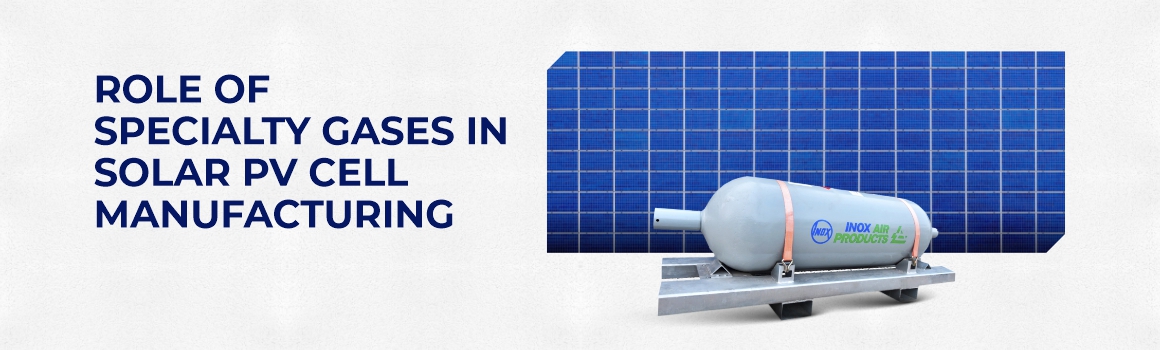
Role of Specialty Gases in Solar PV Cell Manufacturing
Specialty gases are the essential components that are ignored most of the time, though they are necessary in the whole process and are the main contributors to the quality, efficiency, and lifespan of the solar panel.
The gases utilized in the fabrication of solar cells are essential in the steps of deposition, doping, and cleaning. These steps are crucial to produce a solar cell with fine layers and high-performance structures. The quality and precision of the high-purity gases used determine the production of solar cells with high conversion efficiencies. Any deviation can cause a decrease in performance or an increase in defects, which can be very serious for the end product. The gases used for manufacturing solar PV cells are:
Manufacturers who want to keep their competitive edge in the solar market must partner with reliable suppliers of high-purity specialty gases for solar PV cell manufacturing processes. INOX Air Products is the leading manufacturer of industrial gases utilized in solar PV cells. It is widespread across 17 states with 45 operating locations, which is the most in the Industry. Our geographical diversification strategy allows us to effectively handle our costs and logistics, which, in turn, is a great reliability enhancer as a utility supplier by having multiple supply points.
For more information, email us at info@inoxap.com or contact your INOX Air Products Sales Coordinator.
The gases utilized in the fabrication of solar cells are essential in the steps of deposition, doping, and cleaning. These steps are crucial to produce a solar cell with fine layers and high-performance structures. The quality and precision of the high-purity gases used determine the production of solar cells with high conversion efficiencies. Any deviation can cause a decrease in performance or an increase in defects, which can be very serious for the end product. The gases used for manufacturing solar PV cells are:
1.Silane
Silane is the main element in the fabrication of thin-film solar cells, where it is utilized to make a layer of amorphous or polycrystalline silicon on the substrate. It is applied to the tunnel oxide layer in order to obtain the silicon layer of the solar cell structure. The purity of silane affects the uniformity of the silicon layer directly, thus assuring high efficiency of the cell through controlled application, especially the optimal film thickness and layer uniformity. Silane is also employed in the PECVD process, together with other gases, to produce an anti-reflection coating of silicon nitride.2.Hydrogen
Hydrogen is a passivating agent for defects in silicon layers. Passivation is the process that neutralizes dangling bonds and defects in the silicon structure, which would have served as recombination centers for electrons and holes, thus reducing the efficiency. Also, hydrogen can be used with silane and other gases to deposit silicon nitride, which is the anti-reflecting layer that absorbs the light to the maximum extent.3.Nitrogen trifluoride
Nitrogen trifluoride is one of the many gases that are used in solar cell PV manufacturing to get rid of residue films from plasma-enhanced chemical vapor deposition (PECVD) and other chambers. This "dry cleaning" technique is performed by the reactive fluorine radicals that are generated from a plasma-excited nitrogen trifluoride and are used to remove silicon-based residues, thus allowing each manufacturing step to start with a clean surface and result in the overall yield and efficiency of the solar cell being maintained.4.Phosphine and Boron Trichloride
In the manufacturing of photovoltaic (PV) cells, phosphine and boron trichloride are the two essential specialty gases that are strongly used as doping agents to create the two most important p-type and n-type semiconductor layers. The exact and controlled usage of these high-purity specialty gases is the main factor leading to correct doping levels and the uniform layers that are the basis of high conversion efficiencies and the final performance and stability of solar cells.5.Oxygen and Argon
Argon is an essential shielding and purging gas to protect against oxygen during high-temperature processes and to remove impurities, while oxygen is employed to produce silicon oxides that serve as passivation layers or anti-reflective coatings. The ultra-high purity of these specialty gases used for solar cell PV manufacturing is very important for precision manufacturing, as the presence of impurities can have a negative effect on the performance and efficiency of the cells.6.Ammonia
Ammonia is an important factor that leads to gaining efficiency in solar cell technology. It is the compound that is used to deposit silicon nitride (SiNx) layers, which serve as an anti-reflecting coating, and thus light absorption is enhanced. Besides, ammonia is helpful in the formation of the passivating tunnel oxide layer, which leads to surface recombination reduction and better contact between the silicon substrate and metal contacts. The accurate use of ammonia guarantees the evenness of deposition of high-quality layers; thus, the performance and the life of solar cells are increased.7.Nitrous oxide
Nitrous oxide is utilized as a precursor in the making of the tunnel oxide layer and performs an essential function in silicon surface oxidation during the deposition process, where a thin, high-quality silicon oxide layer is created that passivates the surface. Such passivation surface recombination reduction, which, in turn, raises the overall efficiency of the solar cell through better charge carrier collection. Moreover, controlled nitrous oxide usage ensures uniform and accurate tunnel oxide layer formation, which thus secures the solar cells’ long-term performance and stability.8.Nitrogen gas
Nitrogen plays a very important role in the manufacturing of solar PV cells. It acts as an inert carrier that creates a protective, oxygen-free atmosphere for processes such as diffusion, coating, and annealing; thus, oxidation and contamination are prevented. Besides, it makes sure that the materials like silicon nitride and tunnel oxide are uniformly deposited, and it also helps to stabilize the temperature. The controlled environment that this creates leads to fewer defects; thus, the quality of the layers is improved, which is a great factor for charge carrier collection and the overall efficiency.9.Trimethyl Aluminum
Trimethylaluminum (TMA) is a specialty gas used for the fabrication of solar PV cells to deposit an aluminum oxide layer via Atomic Layer Deposition (ALD) or Chemical Vapor Deposition (CVD). The aluminum oxide layer thus deposited reduces surface recombination of charge carriers and the metal oxide layer stabilizes the cell, so the cell becomes more efficient and stable.Conclusion
Specialty gases are the main enablers of solar PV cell production, thus facilitating the generation of high-performing, long-lasting solar panels that are the backbone of the renewable energy revolution. Their exact use, from deposition and doping to cleaning and passivation, constitutes performance and reliability in solar cells.Manufacturers who want to keep their competitive edge in the solar market must partner with reliable suppliers of high-purity specialty gases for solar PV cell manufacturing processes. INOX Air Products is the leading manufacturer of industrial gases utilized in solar PV cells. It is widespread across 17 states with 45 operating locations, which is the most in the Industry. Our geographical diversification strategy allows us to effectively handle our costs and logistics, which, in turn, is a great reliability enhancer as a utility supplier by having multiple supply points.
For more information, email us at info@inoxap.com or contact your INOX Air Products Sales Coordinator.
Get in Touch!
Maximize Productivity With Our High-Purity Gas Solutions